
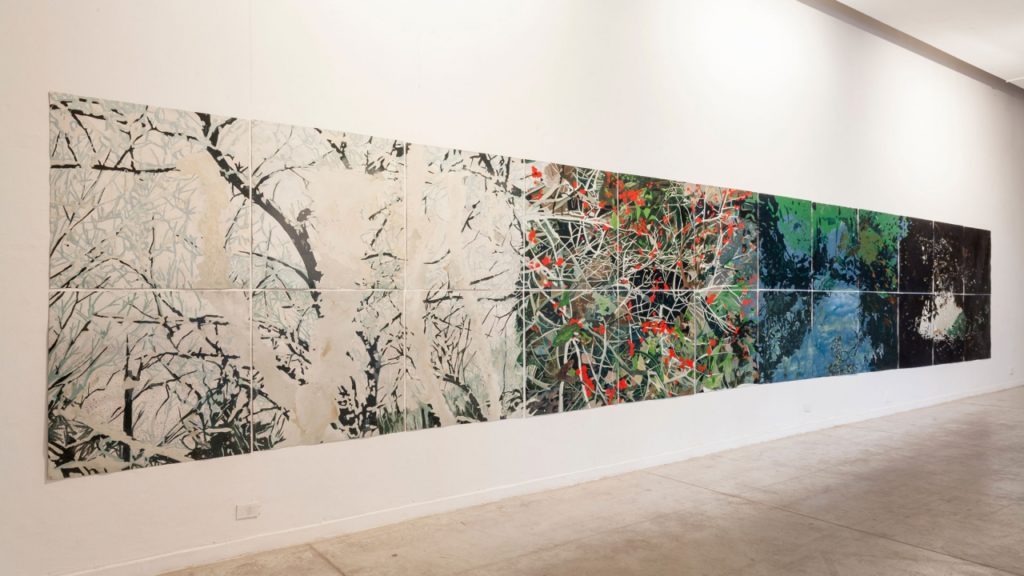
Wilson’s Journey, 2015. Enamel on Metal Panels. 24 Panels 1m2 each, 2 H x 12 L m in total South America.

About the artist

Hernan Salamanco
“Salamanco is interested in beginning a new caste of materials and surfaces, a renovated hierarchy, a superior form of retinalism.” - Rodolfo Biscia
Hernan Salamanco's main practice is the application of media onto surfaces or textures that they often vastly contrast with, most commonly painting enamel onto metal, in order to create a private dialogue between the medium and the surface. His choices in media are frequently referential and loaded with meaning which in turn serves to extend, complement or analogise the subject of the piece. His works are often unnerving, hazy, and throw up more questions than they do answers.
Tin signs by the hundred, in numbers hitherto unknown, began to appear around the neighbourhoods of Buenos Aires during the 2001 economic crisis. The need for cash flow meant that emblems of stability were now for sale. The announcements, written in block letters, signaled changes in ownership and modified the systems of urban belonging. Hernán Salamanco deploys a certain resistance when he confronts the memory of sheet metal. Salamanco chooses synthetic enamel paints as his medium, often used for sign painting, feeling that ‘aristocratic’ oil paints are repulsed by the dents and orifices of a common piece of sheet metal that might even bear signs of earlier use for real estate announcements. In Wilson’s Journey,his chosen materials allow him to escape what art critic Rodolfo Biscia calls the ‘lineage of canvas’: the idea that certain materials and grounds are tied to an overbearing artistic heritage which he wants to detach his work from, retaining an indifference to the illustriousness of oil paint. He feels he must disclaim academic instruction. For Salamanco, there is no room for classic pictorial procedures.