
Anett Lilla Hegedüs graduated from the Painting Department of the Hungarian University of Fine Arts in 2009. Her mentors included Sándor Molnár, Orsolya Drozdik, and Eszter Radák.
In the late 2000s, she began exploring the concept of personal space as both a physical and intellectual field of movement, focusing on the relationship between spatial freedom and identity (Fictive Spaces, from 2008). Starting from this notion of mental space, she soon turned to examine the interaction between the individual and the community — placing particular emphasis on the essential role of human nature in both individual and societal development, as well as the complex relationship between the consumer society and the individual within it.
Since the beginning of her career, her work has centered on the themes of identity, knowledge, and the human connection to the environment, with a special focus on the dynamics between individual and collective self-understanding, and between spiritual and physical space. Early series such as Fictive Spaces (2008) and Lollipops (2006) explore the construction of identity and personal space within the context of consumer culture.
Hegedüs’s practice is intellectually layered and conceptually grounded, yet remains responsive to urgent social, ecological, and technological issues. Her sculpture Water (2012) — a female nude cast in translucent polyester resin — reinterprets the classical artistic portrayal of the female body while also engaging with contemporary environmental concerns. The choice of material and the air bubbles trapped within the figure serve as a poignant reference to the growing discourse around microplastic pollution.
Her 2025 work Átman, a transparent, multi-layered resin sculpture of a meditating human figure, investigates ideas of consciousness, spiritual expansion, and universal human identity. Inside the head of the figure is a miniature Earth, around which concentric translucent layers are arranged like onion skins. This construction evokes the accumulation of knowledge, the gradual comprehension of the world, and the fragile relationship between modern humans and their environment. The piece operates on both visual and symbolic levels — responding to light, it becomes a nearly interactive painting, where microscopic and cosmic imagery converge.
Hegedüs’s artistic practice examines complex issues through a distinctive visual language. Her sculptures are not merely aesthetic objects, but spatial manifestations of intellectual and spiritual inquiries. Her work is particularly relevant to contemporary conversations about sustainability, the human–technology relationship, and the universal and social interpretations of identity.
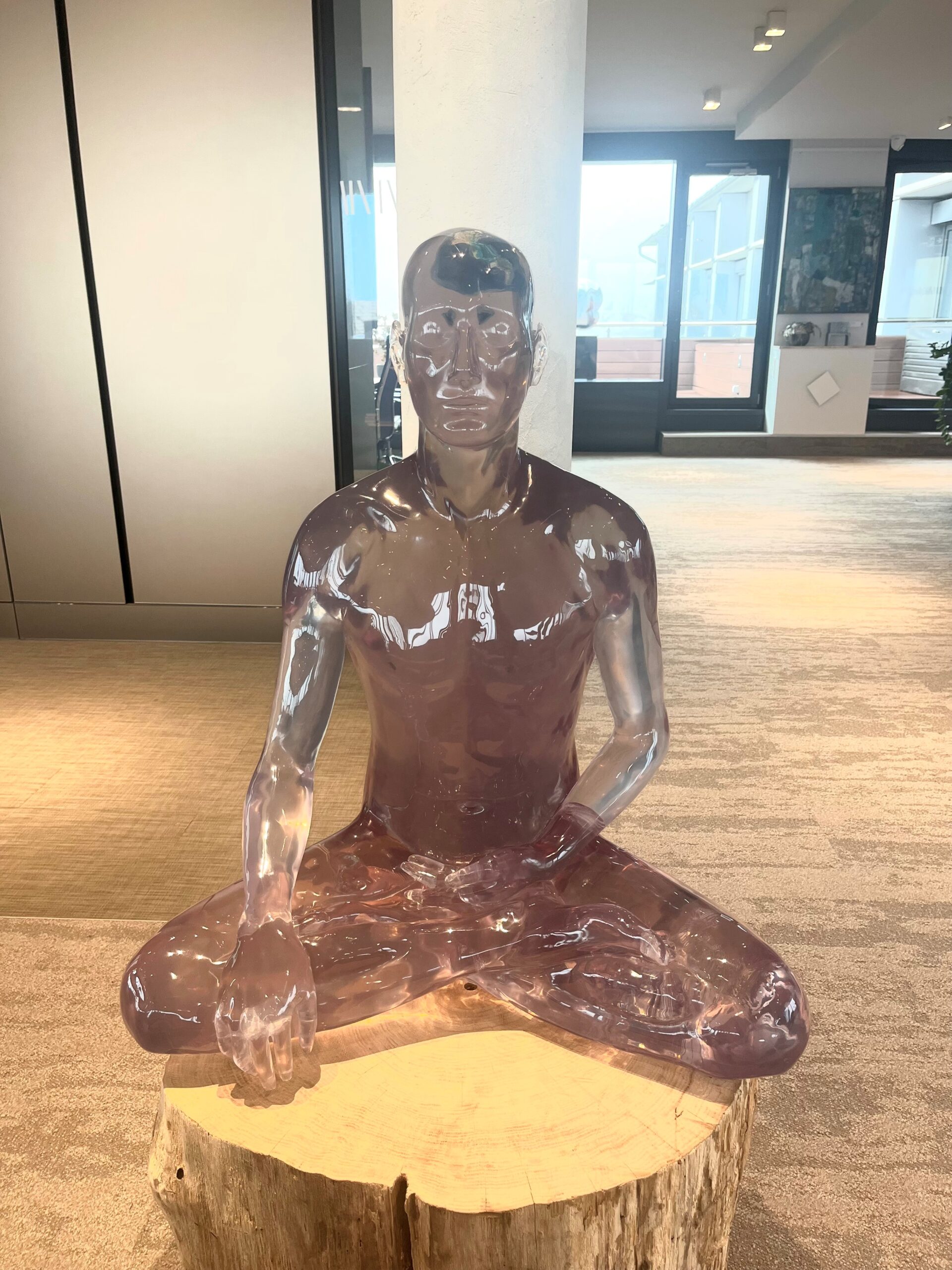
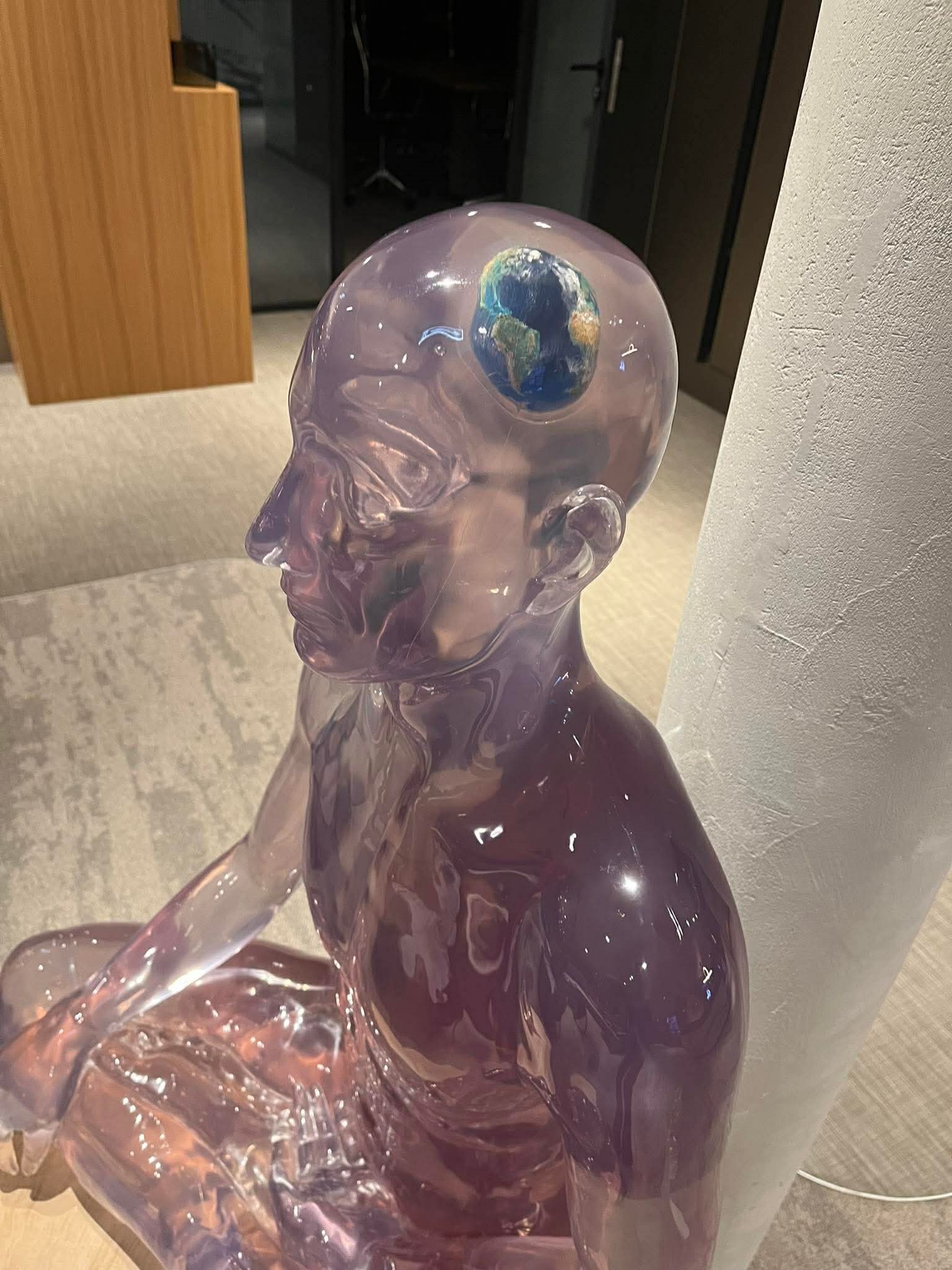
Átman
2025
86 × 75 × 48 cm
mixed media (oil paint, polyester resin, wood)